
Overview
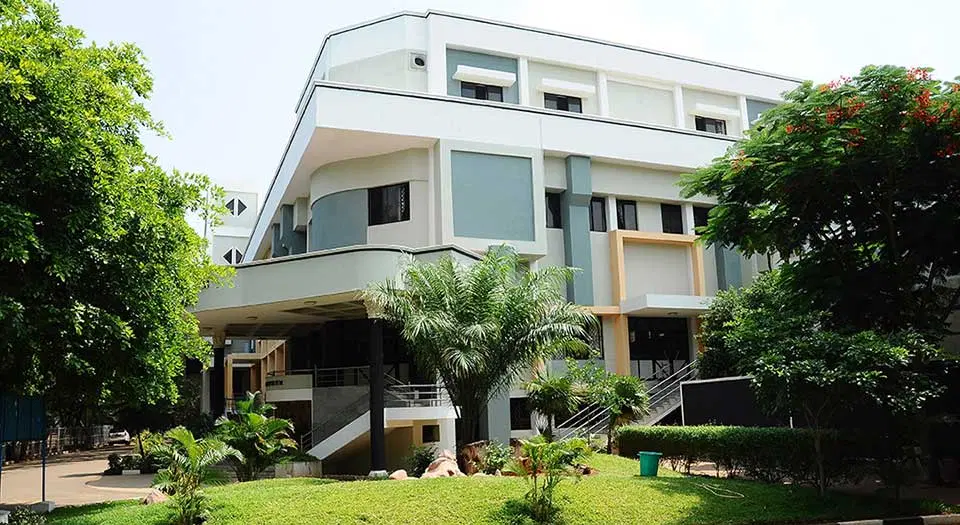
Bishop Heber College fosters a sense of connectedness and ecological citizenship in responding to the environmental challenges while preparing the Students as environmental stewards of God's creation. Realizing the God-given mandate to take care of the earth, the College with various Departments like Environmental Sciences and Biology continuously focuses on the mission to ensure Environmental Sustainability, Preservation and Restoration of nature.
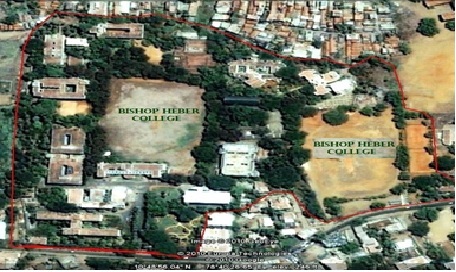
The College campus was built originally on the alluvial clayey soil where there used to be cultivation of Paddy and other agricultural crops over generations. The campus spreads across 23.5 acres of land area with the open green cover occupying 15.96 acres (nearly about 60% of the total area) and the remaining area is occupied by nearly 40 buildings intermingled with metal roads.
23.5
Total Acres
15.96
Green Cover (Acres)
60%
Open Green Area
167
Plant Genera
Environmental Policies
The procedures and policies for Environmental Consciousness in Bishop Heber College are enshrined in the following policies:
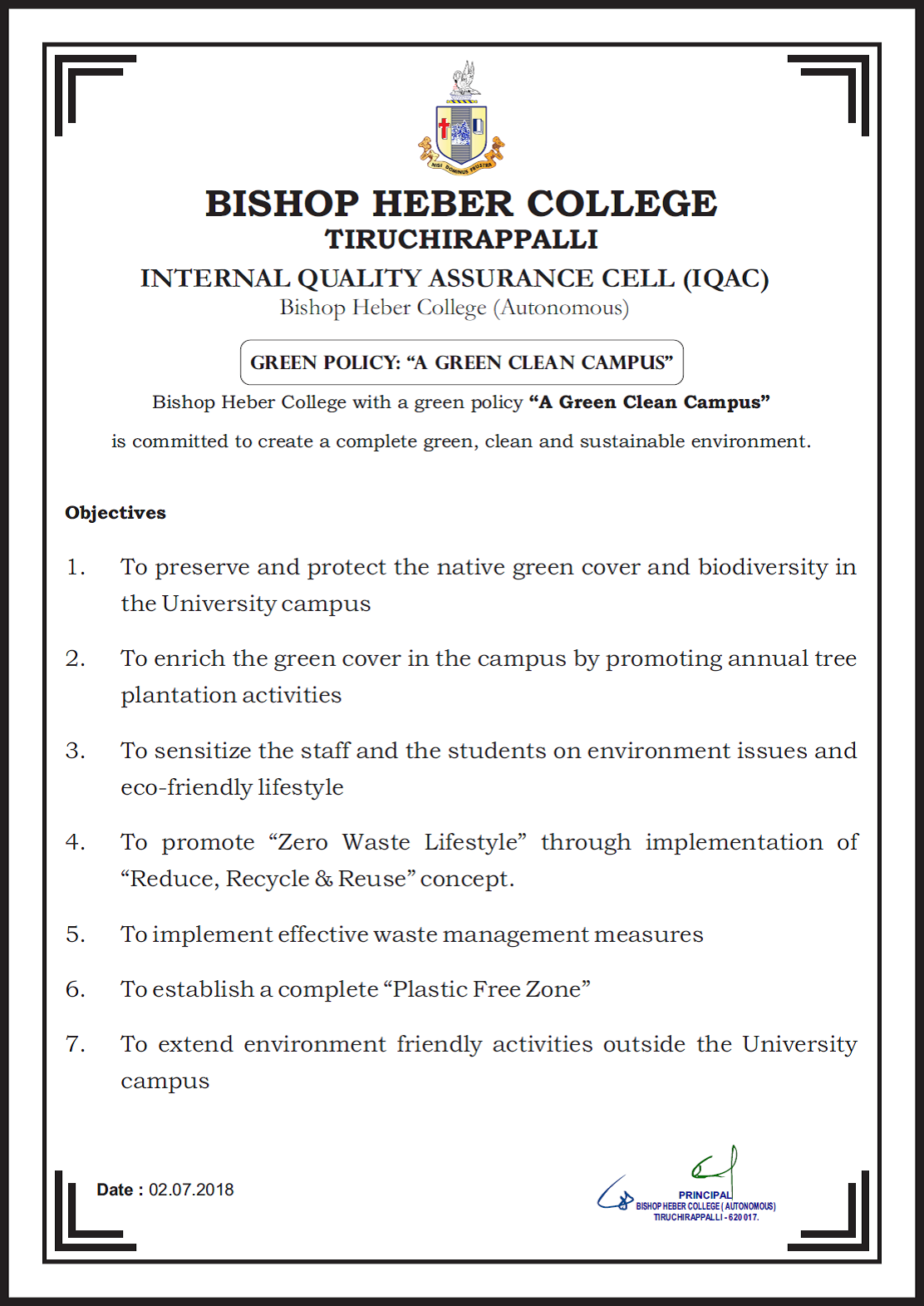
Green Policy
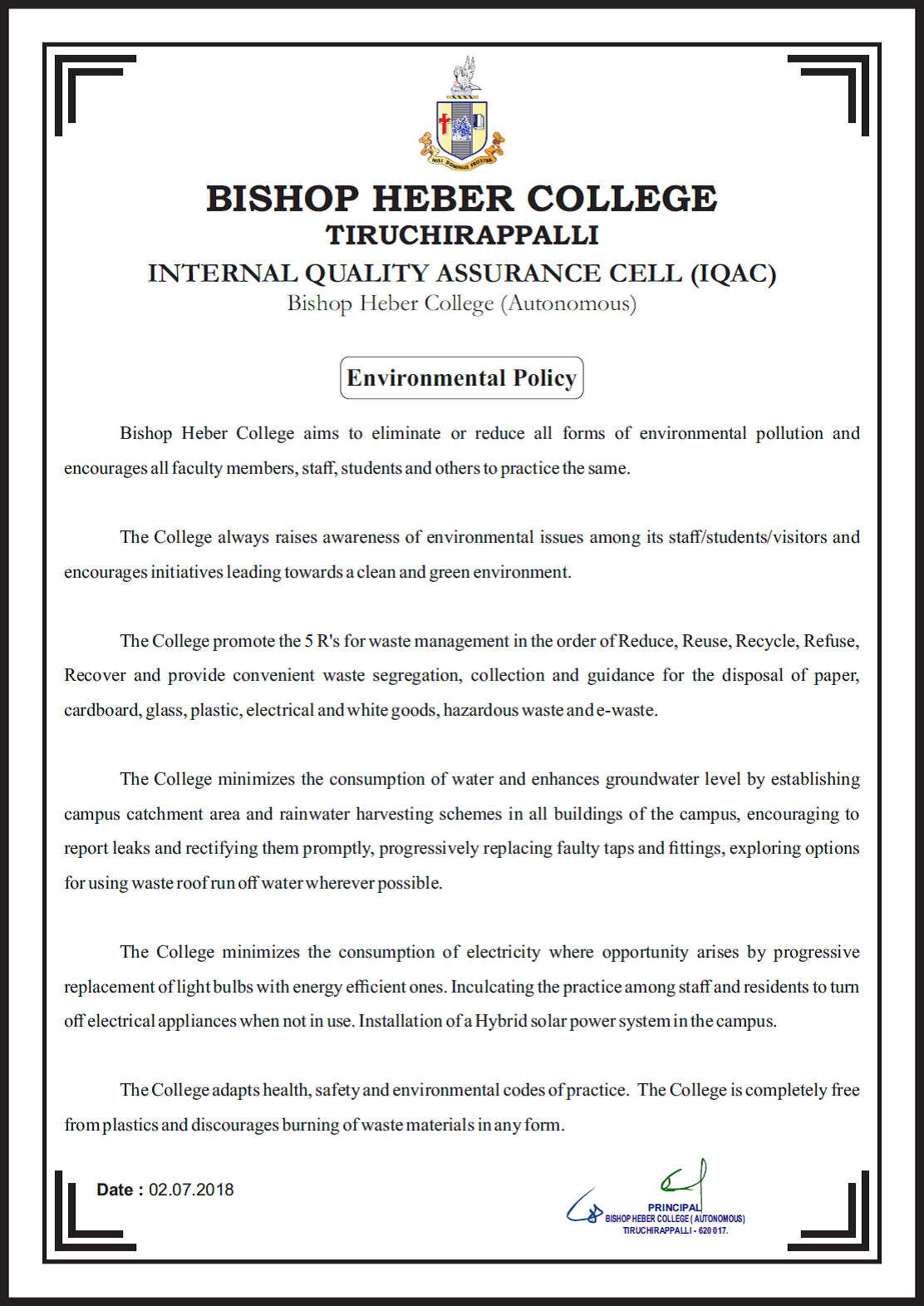
Environment Policy
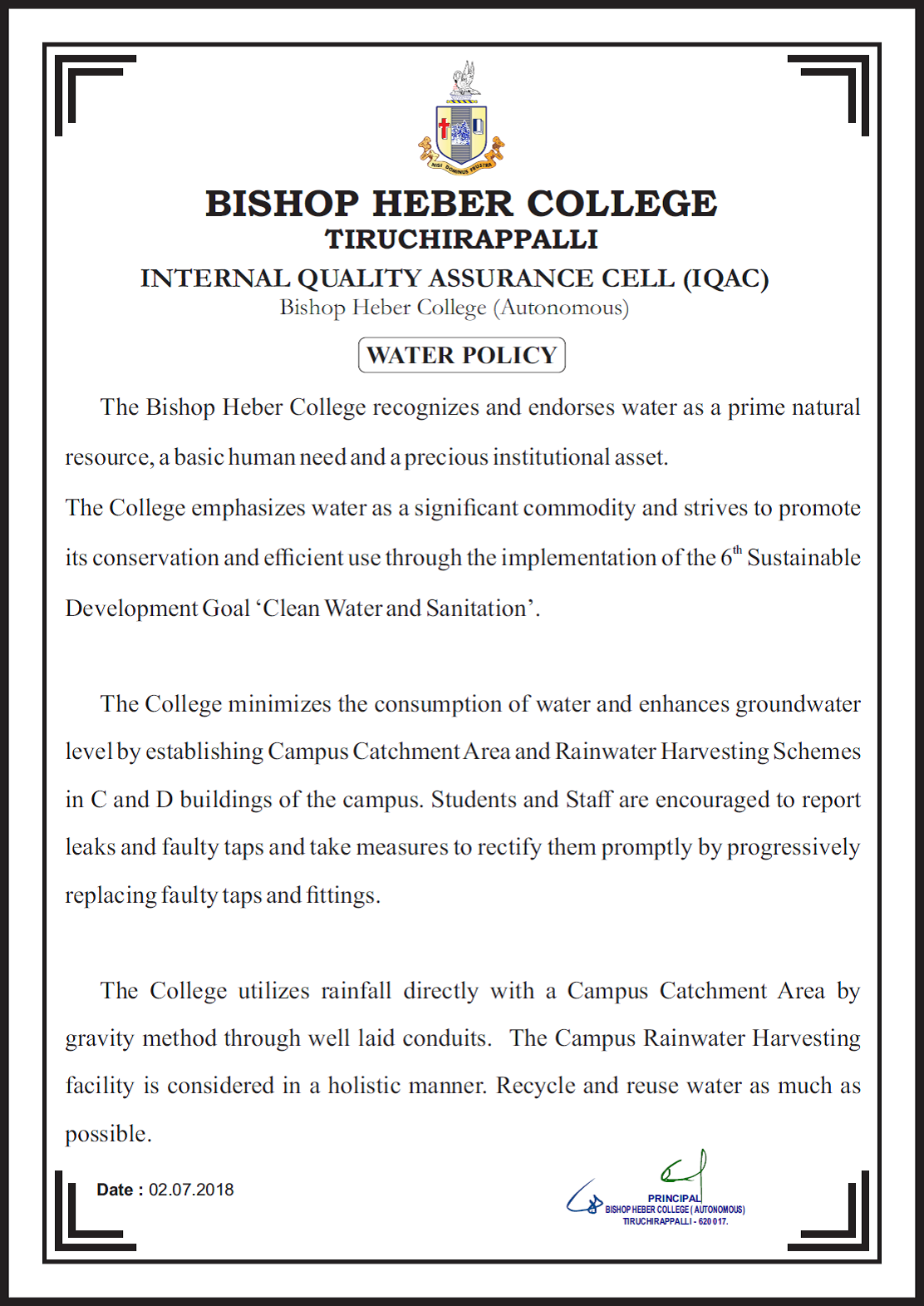
Water Policy
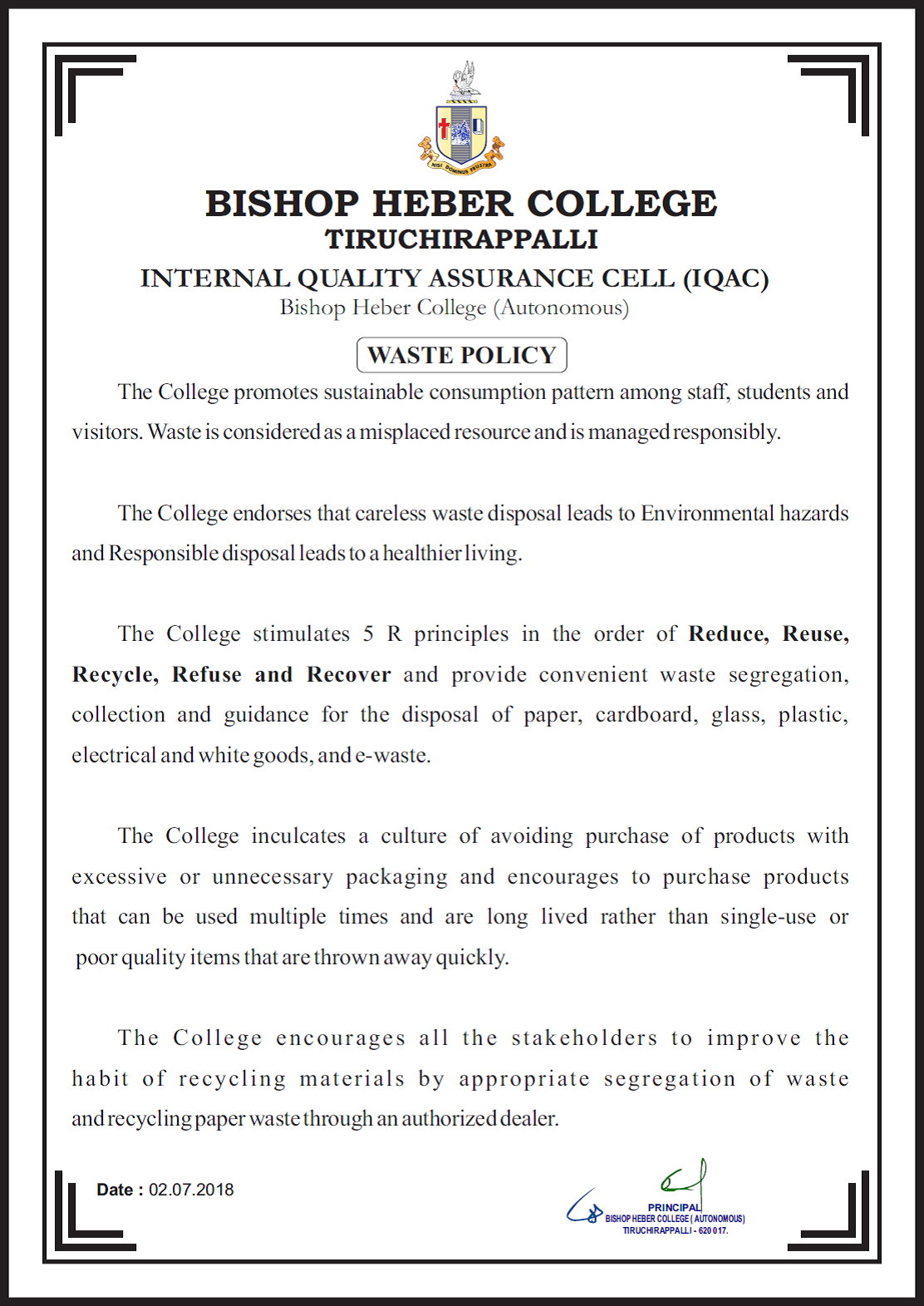
Waste Policy
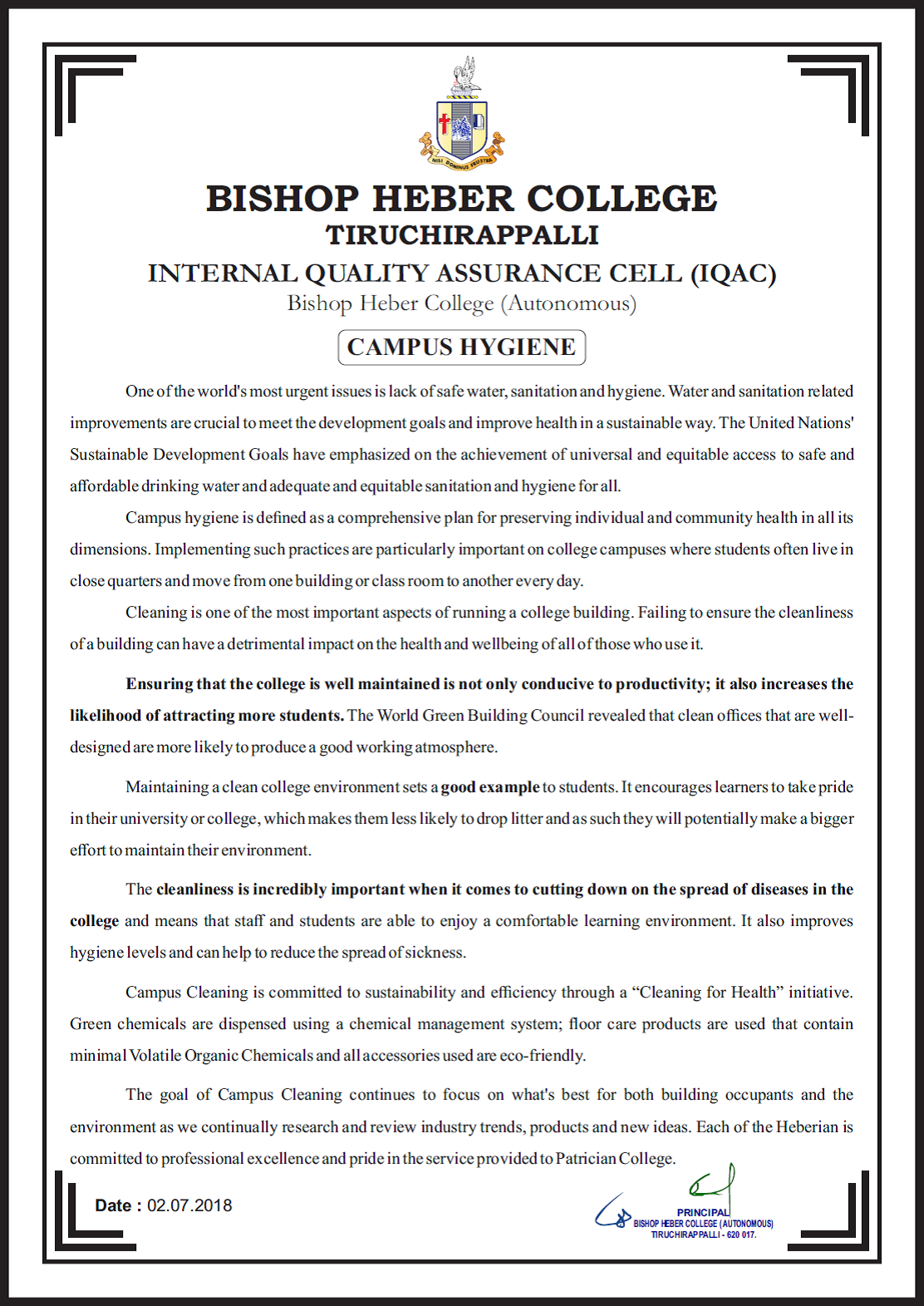
Hygiene Policy
Energy Conservation
Solar Energy
Solar energy is a clean, green, and non-polluting energy source. Sunlight can be used directly for heating and lighting homes and businesses, for generating electricity, and for hot water heating, solar cooling, and a variety of other commercial, industrial and educational sector uses. Bishop Heber College (Autonomous), with an area of about 32 acres and a population of around 13,000, has embraced solar energy as a key part of its energy strategy.
Solar Water Heater
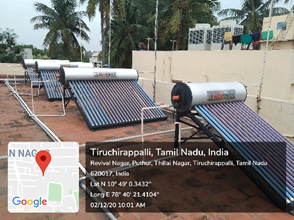
Solar water heater – view 1
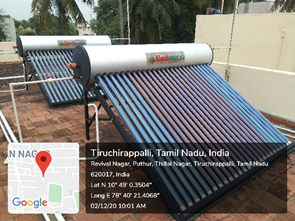
Solar water heater – view 2
Biogas
Biogas Plant
Biogas is produced after organic materials (Plant and Animal Products) are broken down by bacteria in an oxygen-free environment, a process called anaerobic digestion. Biogas systems use anaerobic digestion to recycle these organic materials, turning them into biogas, which contains both energy (Gas), and valuable soil products (Liquids and Solids).
A biogas plant is constructed between the Gardiner hostel and the mess workers quarters of 238 m³ capacity, which can utilize 600–700 kg of Night soil and 500 kg of food waste/day to produce 35–40 kg of biogas daily.
Composition of Biogas
| Substance | Symbol | Percentage (%) |
|---|---|---|
| Methane | CH₄ | 50 – 70 |
| Carbon Dioxide | CO₂ | 30 – 40 |
| Hydrogen | H₂ | 5 – 10 |
| Nitrogen | N₂ | 1 – 2 |
| Water Vapour | H₂O | 0.3 |
| Hydrogen Sulphide | H₂S | Traces |
Capacity
Layout of Biogas Plant installed in Bishop Heber College
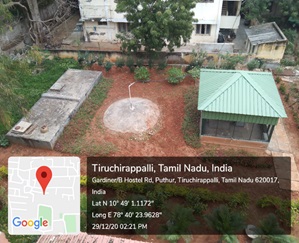
Biogas plant – aerial view 1
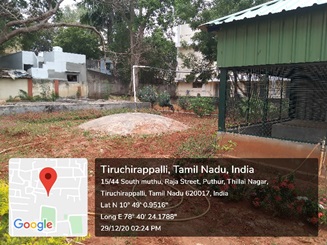
Biogas plant – aerial view 2
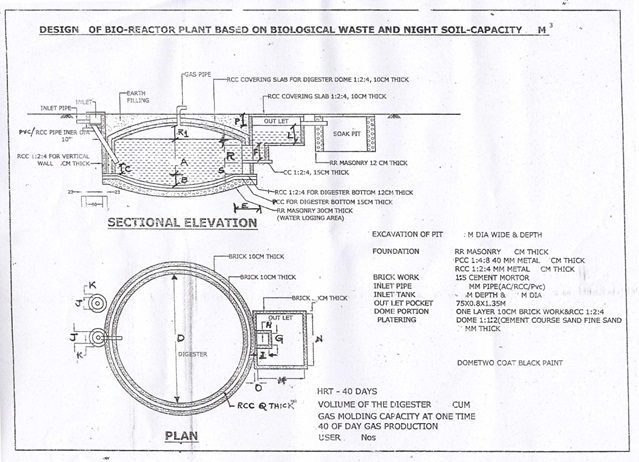
Biogas plant layout diagram
Energy-Saving Measures & Carbon Footprint Reduction
The Energy Audit Report of the College during the period 2019–20 recorded a total electricity consumption of 2,161,804 units. This includes air conditioners which consume about 20–24% of electricity. One electrical unit (EU) equals consumption of 1000 watts per hour (1 kWh) and requires 0.538 kg or approximately ½ kg of coal to produce the same.
The total quantity of coal required to produce 2,161,804 units = 11,63,050.55 kg or 1,163 tons. CO₂ emission by coal: 1 kg of coal emits 2.86 kg of CO₂. Therefore, consumption of 2,161,804 units led to the emission of 3,326,323 kg or 3,326.3 tons of CO₂ into the atmosphere.
The management of Bishop Heber College is conscious of this damage and has been implementing various programs to reduce energy consumption and increase green energy sources.
CO₂ Reduction Measures
- 1Replacing high energy-consuming lighting system with energy-efficient lighting systems.
- 2Installing a 1.5 KVA pilot solar PV power system through which analysis of CO₂ reduction is succeeded.
- 3Installing energy-efficient lighting system. Based on the recommendations of the Energy Audit conducted this year, the Institution has reduced CO₂ emissions indirectly by replacing high energy-consuming electric bulbs with energy-efficient LED lighting systems.
- 4Average energy by LED 6W–12W max and energy consumed by LED 1,12,400 KWh per Annum or 1,12,400 electrical units.
I. LED Lamps in the Campus
The Institution has installed LED tube lights across the campus. Total units consumed by LED lamps = 1,12,400 units. Coal equivalent = 60,471.2 kg or 60.47 tons. At this rate, 60,471.2 kg coal emits 1,72,947.6 kg or 172.94 tons of CO₂ — which is 22% less than regular consumption by conventional devices.
II. Solar Energy Available in the Campus
Ten solar panels (each 4×3 ft.) installed on the terrace produce 180 W each. Panels function effectively for about 10 months per year (300 days).
Available solar power: 1.5 KVA
Annual generation: 1.5 KVA × 80% × 10 hrs × 280 days = 3,360 KWh
Grid export (non-working days): 1,200 KWh
CO₂ equivalent of 1,200 units = 645.6 × 2.86 = 1,846 kg or 1.85 ton reduced per annum.
Carbon Offset of the Campus
A total of 174.125 tons of CO₂ reduction (172.94 tons via LED lamp replacement + 1.85 tons via solarisation) is measured to be eliminated per annum. The campus is eco-concerned and adapts all possible resources.
Clean & Green Campus Recognitions / Awards
Awards and recognitions received for the college's green campus initiatives will be listed here.
Solid Waste Management
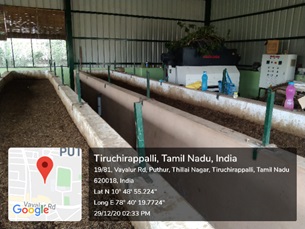
Vermicompost facility – view 1
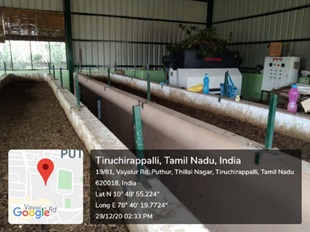
Vermicompost facility – view 2
The green treasures which spread across the campus are recorded with 167 genera of plants categorized into Herbs, Climbers, Grasses, Shrubs and Trees. Trees represented the highest number of genera with 74, followed by Herbs (59), Shrubs (4), Climbers (13) and Grasses with 17 species.
Though the tree population is lesser in number, they contributed to the maximum diversity in terms of genus. This is due to the fact that the trees were planted all along the campus and also with the maintenance of Arboretum inside campus where nearly 25 genera are maintained.
The herbs that outnumber in terms of population grow naturally all along the entire campus. The college strives its best to maintain the green cover in the campus through which the college gains its popular name "The Beauty Bishop".
74
Trees
59
Herbs
13
Climbers
17
Grasses
4
Shrubs
Green Initiatives
- 1Rain water harvesting.
- 2Environmental education to school children, International students and to the local public by eco-tours, field trips and nature camps.
- 3Bird watching, survey, rescue, breeding and release of orphaned or abandoned birds.
- 4Environmental awareness campaigns by observation of No Vehicle/Drive Day, World Environment Day, Forest Day, Sparrow Day, Water and Earth Day.
- 5Tree planting, establishment and maintenance of nursery and issuance of saplings to different beneficiaries like NSS, NCC and other voluntary agencies.
- 6Establishment of Arboretum, Ficadorium, Bambusetum and Medicinal plant garden for education and creating awareness.
- 7Conservation of endangered and endemic plants from the ecologically sensitive Western Ghats Mountains (One of the Hot Spots of Biodiversity) using Micro propagation and other breeding methods.
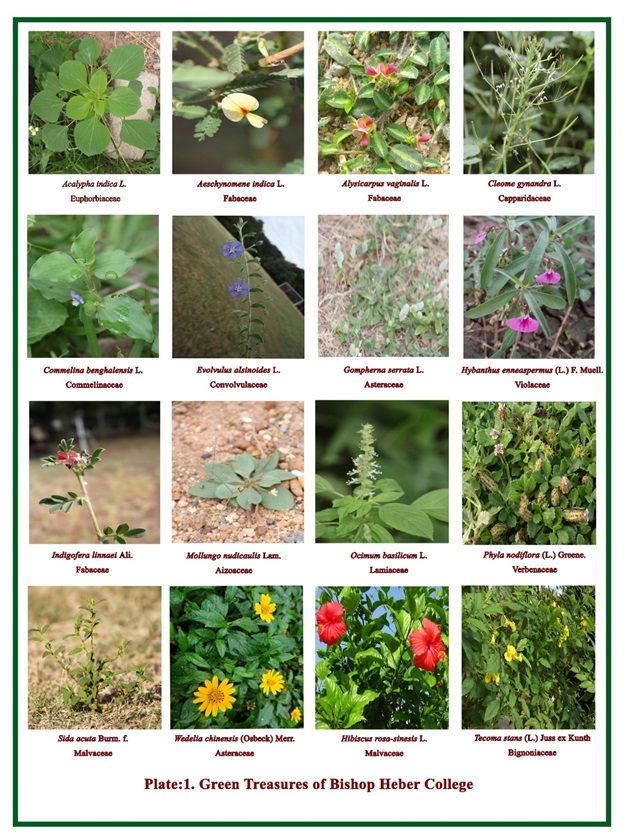
Plate 1: Green Treasures of Bishop Heber College
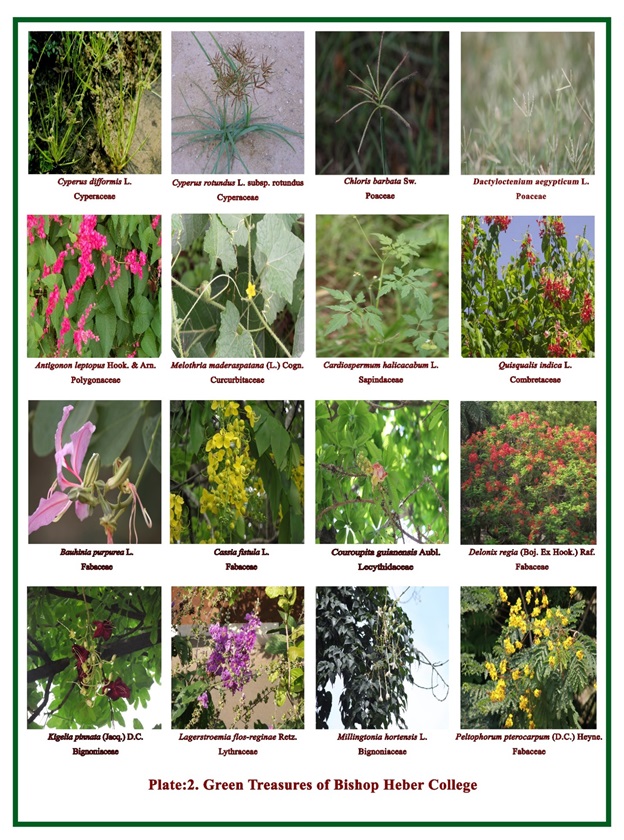
Plate 2: Green Treasures of Bishop Heber College